
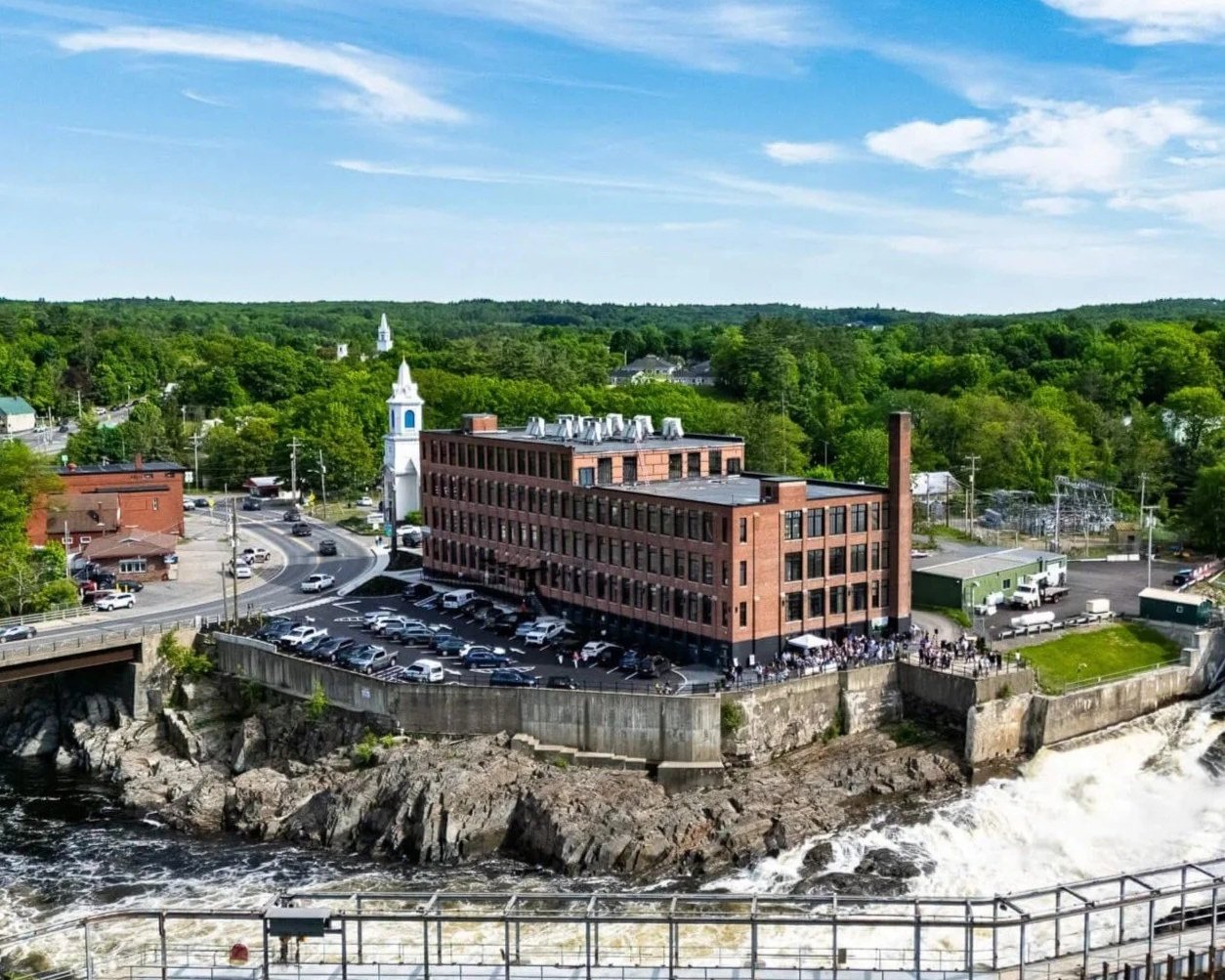
The high-profile redevelopment of the Spinning Mill exemplifies the transformative effect of an adaptive reuse project–turning Skowhegan’s shuttered mill into a beacon for the community by providing new jobs, housing, and accommodations.
The Maine Spinning Company Mill was erected in 1922 at the heart of downtown Skowhegan, where the main roads connecting Bangor, Quebec, and central and southern Maine intersect. The company first leased space in a complex of wood frame mill buildings across the Kennebec River in 1904. Lockwood, Greene & Co., the leading mill engineering firm at the time, is credited with the innovative and efficient design of the three-story, brick mill, which integrated fully electric-driven machinery, full fire protection, double-glazed windows, and steam heat and humidification to ensure both worker health and efficient production. An additional floor added in 1946 brought the mill’s size to 80,000 square feet.
Following several mergers, Solon Manufacturing Company was the mill’s last operator and closed its doors in 2005. A discount retail warehouse company filled the first floor, delaying its full vacancy until 2019. Inside, failure of the roof resulted in significant water infiltration and thus damage to hardwood flooring in much of the building. Many of the windows were removed or damaged and covered with metal roofing material. The highly visible mill, that once employed upwards of 300 residents to produce 2 million pounds of yarn a year, sat vacant giving the impression of a depressed and failed community.
In 2017, Jeff and Pam Powers, owners of Bigelow Brewing, purchased the mill for brewing and canning operations and a brew pub. For help redeveloping the rest of the site, a mutual connection introduced Dash Davidson and Max Patinkin of High Tide Capital, whose adaptive reuse projects were contributing to downtown Bangor’s resurgence. Sadly, Jeff unexpectedly passed away in 2023, with High Tide Capital taking the reigns of the project.
In another tragic turn, a "100-year" flood in December 2023 inundated the lower story of the building mid-construction, causing an estimated $3 million in damage, including stored materials for use on the upper floors. However, a Business Recovery & Resilience Grant from the State of Maine helped safeguard the project’s viability.
One of the most striking parts of the transformation was the return of historically appropriate, 8-foot-tall windows, bringing both light and a sense of vitality to the mill. New hardwood flooring was installed on the main floors, while original riveted steel framing, wood ceilings, and brick walls remained exposed. The plans for reuse, led by DJLU Architects with support from Hanson Historic Consulting and executed by Pike Project Development, included a 20-room boutique hotel, coworking space, gym, and 41 apartments. The top of the original concrete coal bin was repurposed as a riverside patio for the new restaurant Biergarten. In addition, a 5,000 square-foot rooftop deck now overlooks the Kennebec River. The industrial loft-style hotel rooms and apartments have provided a new type of hospitality and living space to the region.
The Spinning Mill has reclaimed its prominence in the heart of Skowhegan.
Project Participants:
High Tide Capital
Djlu Architect
Pike Developers
High Tide Capital
Kasa
Hanson Historic Consulting
Skowhegan Economic Development Corporation
Biergarten
Photo Credits: Bigelow Brewing, High Tide Capital, Hanson Historic Consulting, Maine Historical Society
